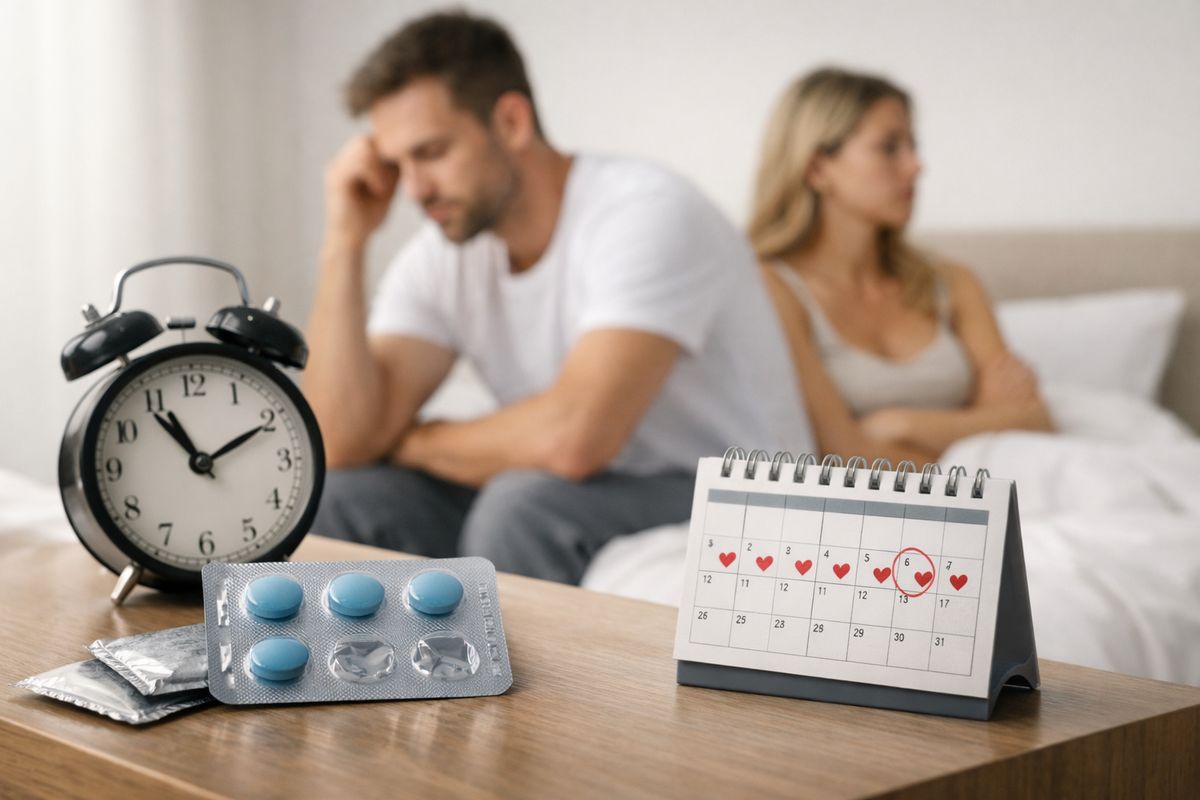
Planning sex around ED pills means timing intimacy around when medication might work, instead of when you actually feel close, interested, or in the mood. If that sounds familiar, the problem usually is not just erectile dysfunction itself. It is the whole routine around it, the clock-watching, the waiting, and the pressure that can make sex feel more staged than natural.
Why Sex Starts Feeling Like a Scheduled Event
It often starts with a small mental calculation. You look at dinner plans, think about drinks, check the time, and realize intimacy needs to fit inside a pill window. That shift matters more than it seems.
Once sex starts revolving around medication timing, spontaneity takes a hit. Instead of responding to a moment on the couch, a lazy Sunday morning, or a quick spark after getting home late, you end up managing conditions. The experience starts feeling less like desire and more like making a connecting flight.
What “planning sex around ED pills” really means
In plain English, it means your sex life starts depending on prep work. You take medication ahead of time, wait for it to kick in, think about whether you ate too much, wonder if alcohol will interfere, and hope arousal lines up with the best response window.
That does not mean the medication is useless. It means the treatment setup is built around timing. And when timing becomes the boss, intimacy can start to feel stiff even if the drug itself helps.
Why this gets frustrating fast
Here’s the thing: pressure does not stay neatly in the background. If you know a pill needs a certain lead time, every delay can feel loaded. A late meal, a second glass of wine, or simple fatigue can suddenly seem like part of a larger problem.
That frustration can turn into performance anxiety fast. If a night only feels like it “counts” when everything lines up perfectly, your mind starts monitoring the process instead of enjoying it. That is a bad trade.
Why ED Pills Often Push You Into Planning Ahead
A lot of ED medication works by improving blood flow, but the experience of using it depends on more than that. Timing, absorption, duration, and your body’s response all shape whether the night feels easy or overly managed.
So yes, the pill matters. But the routine around the pill often matters just as much.
Onset time: the waiting game
Many ED pills are not instant. That is the main reason sex gets scheduled in the first place. You take a dose, then wait, sometimes 30 minutes, sometimes longer, depending on the medication and your body.
Some options act faster than others, but “faster” still does not mean immediate. The catch is that even a reasonable wait can change the tone of the whole experience. Once you are watching the clock, the mood is already different.
Food, alcohol, and routine can change the experience
Real life gets in the way. A heavy meal can slow absorption for some medications. Alcohol can dull arousal or make results feel less predictable. Even simple mistakes, like taking the medication too late or expecting it to work without sexual stimulation, can lead to disappointment.
That is why ED pills can feel inconsistent even when the prescription itself is fine. It is not always user error, exactly. It is that normal life is messy, and a treatment that depends on precise timing can feel unreliable inside a messy life.
Not every erection problem is only about blood flow
Blood flow matters, but it is not the whole story. Erections depend on a brain-body connection, meaning your mind, nerves, stress level, and physical response all need to work together.
So if distraction, stress, or performance anxiety is part of the picture, a circulation-focused treatment may only solve part of the problem. You can have support for blood flow and still feel mentally stuck. That is more common than people admit.
What Traditional ED Meds Do Well, and Where They Fall Short
Traditional ED medications can help a lot. That deserves a clear, direct statement. For many people, these drugs improve erections enough to make sex possible and satisfying again.
But effective does not always mean easy. And it definitely does not always mean spontaneous.
The basic difference between short-window and longer-window options
Two of the best-known options work a bit differently. Sildenafil is often used for stronger short-term support around a specific encounter. Tadalafil is often associated with a longer duration, which can create more flexibility.
Think of sildenafil like booking a specific time slot. Think of tadalafil more like having a wider window open. Both can be useful, but the feel is different.
Why longer-lasting meds can feel less rigid
Tadalafil is often linked with spontaneity because its longer half-life can extend the effect window. In practice, duration changes everything. If support lasts longer, you stop racing the clock quite so hard.
That does not mean every problem disappears. But it does mean intimacy can feel less scheduled, which is often the real complaint in the first place.
Side effects and safety still matter
Common side effects can include headache, flushing, nasal congestion, upset stomach, or back pain, depending on the medication. Safety matters too. ED drugs should not be mixed with nitrates, and treatment that is not working well should be reviewed by a clinician rather than endlessly adjusted at home.
That part is not optional. Convenience is great, but it does not replace proper screening.
The Bigger Issue: Fixing Erections Isn’t the Same as Fixing Spontaneity
A pill can technically work and still leave you unhappy with the experience. That is the deeper point. The real frustration is often not “the pill failed.” It is “sex still feels staged.”
That distinction matters because it changes what kind of solution actually fits your life.
Performance anxiety can get worse when everything depends on timing
If the dose, the mood, the schedule, and your body all have to line up, pressure builds. Once pressure builds, your attention shifts toward monitoring performance. You start checking yourself instead of being present.
And yes, that can make erections harder to maintain, even with medication on board. The mind is not a side note here. It is part of the mechanism.
Why “take it slow” doesn’t always solve the problem
Slowing down can help with arousal and comfort. That advice is not wrong. But it does not remove the countdown if the treatment still depends on waiting for a drug to hit a specific window.
So while “take it slow” sounds sensible, it often misses the actual complaint. The problem is not only pace. The problem is planning.
What Newer ED Treatment Systems Are Trying to Change
Newer ED treatment models are trying to reduce that sex-by-schedule feeling. Instead of relying only on a single on-demand pill, some telehealth programs build in more flexibility by combining daily support with an on-demand boost.
The idea is simple: be more ready in general, then have extra help available when you want it.
The daily-readiness plus on-demand approach
This two-layer setup aims to cover two different needs. One part supports day-to-day readiness, so intimacy does not always start from zero. The other part is there for moments when you want stronger support.
That makes intuitive sense. If your baseline is steadier, you may not feel like every encounter depends on a perfectly timed dose.
Example: how Vigo MD positions its two-part system
Our Vital V3 Protocol is exactly this kind of two-part setup. The program pairs a daily Vital Chew for ongoing support with a V3 dissolvable tablet for planned intimacy.
That is a different framing from the standard one-pill model. It is not just “take this before sex.” It is “support readiness more consistently, then add another layer when needed.”
What’s in it, in simple terms
Vital Chew contains tadalafil 5 mg, vardenafil 5 mg, vitamin D3 200 IU, and vitamin K2 1 mg. The V3 tablet contains apomorphine 4 mg, sildenafil 70 mg, and tadalafil 20 mg.
Apomorphine is the interesting part here. Unlike PDE5 inhibitors such as sildenafil and tadalafil, apomorphine acts on dopamine pathways tied to arousal and motivation, not just blood flow. In simple terms, the formula is trying to address both physical response and mental readiness.
Why speed and duration are such a big deal
The V3 tablet is sublingual, so absorption starts under the tongue instead of relying on digestion, and tadalafil stays active in the body longer than sildenafil. Onset and duration vary between individuals, but the appeal of the design is obvious.
Speed reduces the need to plan far ahead. Duration reduces the feeling that you have one narrow shot. Put those together and intimacy can feel a lot less rigid.
Is a “Better Solution” Just a Different Pill, or a Different Setup?
A better solution is not always a stronger dose. Sometimes it is a treatment setup that matches real life better. That is an important distinction if your current routine feels annoying, stressful, or weirdly formal.
If the system makes you feel like you need a spreadsheet for sex, the system is probably the problem.
Signs your current approach is the wrong fit
A poor fit often looks obvious once you name it. You keep watching the clock. You avoid spontaneous moments because the timing is off. You feel pressure every time. Results seem inconsistent. Intimacy now requires logistics, like checking food, drinks, and timing before you can relax.
Those are not small side issues. That is the actual experience of treatment, and it counts.
What to look for in a more flexible treatment plan
A more flexible plan usually gives you some mix of faster onset, longer duration, support for both blood flow and arousal, clear instructions, and proper safety screening. It should also fit your actual routine, not some ideal version of your life where dinner is always light and timing is always perfect.
That practical fit matters more than flashy promises. The best treatment is the one you can use without turning intimacy into a production.
Telehealth, privacy, and convenience
Convenience is part of treatment quality too. Remote physician review, discreet shipping, and easy follow-up can make it much easier to actually stick with a plan.
Sometimes the easier process helps just as much as the formula. Less friction counts.
Questions Worth Asking Before You Switch
A switch makes sense when the current problem is bigger than erection quality alone. If the real issue is that sex feels overplanned, the next move should focus on flexibility, not just force.
Could a daily option make sex feel less scheduled?
For some people, yes. A daily-treatment approach can reduce rigid planning because support is not tied to a single event in the same way. If flexibility matters more to you than hitting one exact window, that kind of setup can feel more natural.
Does a faster-onset option automatically mean better sex?
Not automatically. Speed helps with spontaneity, but the full experience still depends on arousal, comfort, side effects, safety, and whether anxiety is in the mix. Faster is helpful, not magical.
What should you try next?
Write down the exact part of your current routine that feels worst: the waiting, the pressure, the side effects, or the loss of spontaneity. That one detail can point you toward a better treatment conversation.
Traditional ED pills often work, but they also often push you into planning ahead. If that planning is what’s wearing you out, a setup built for more flexibility may be the better fix. Our V3 protocol is designed around that idea, aiming for a shorter wait and a wider window so intimacy can feel more like your life again, and less like a timed event.
Treatment matched to your situation
Complete a private online questionnaire, get reviewed by a licensed physician, and have treatment shipped discreetly if it is appropriate for you.
Start your consultation